
ASAP Curators’ Circle
Art South Asia Project (ASAP) is delighted to announce Curators’ Circle, a programme developed for their 17th edition of March Meetings, hosted by Sharjah Art Foundation (SAF). For the March Meeting 2026: Between Us, the World, ASAP invites a delegation of curators from each of the South Asian countries we work with: Bangladesh, India, Nepal, Pakistan, and Sri Lanka. This is a distinctive programme developed to strengthen collaboration between South Asian curators and leading international art professionals with a special emphasis on members of the global majority. Being part of the larger international cohort offers ASAP curators a unique opportunity to learn about diverse practices, develop new research interests, and hone their curatorial skills.
The theme for MM 2026: Between Us, the World is an opportunity for members of the art community to recognise and reflect on the current climate of social unrest, environment degradation and systemic erasure. The discussions are expected to reveal curators’ strategies of care and community oriented practices developed as responses to regional/ global pressures. MM 2026 offers a space for deliberation and exchange, highlighting the fragile bonds that hold us together and invoking the creative possibilities that can emerge from them.
ASAP’s Curators’ Circle has been developed in collaboration with SAF to support a shared commitment to professional development and institutional capacity building in the arts.
The programme is supported by QissaGoi (UAE). QissaGoi is a space where we share and honour South Asian and Middle Eastern stories through art, conversation, and community. Based near Sharjah’s cultural district in the UAE, we bring people together through online platforms and live events that encourage connection, creativity, and cultural exchange.
ASAP Curators’ Circle: Online Programme
Owing to the conflict within the Middle East and escalating tensions between USA and Iran, Sharjah Art Foundation’s March Meeting 2026 has been postponed. Art South Asia Project designed an interim series of closed-door online conversations with the five participants in ASAP’s Curators Circle. The programme is a series of three panel discussions where ASAP, Qissagoi and the cohort engage with the MM 2026 theme Between Us, The World, with a keen focus on South Asian regional peculiarities and challenges.
The programme is an effort to reclaim togetherness and connectivity across borders, something constantly severed because of the political and economic interests of global leaders. The series will allow curators to explore each other's practice, think collectively about curating in the current climate, and reflect on a future where the global south's collaborative work continues. The series is imagined as a space for open dialogue and collective thinking, building momentum towards the rescheduled gathering in Sharjah.
About the Selected Curators:
Bishal Yonjan is a visual artist and curator based in Kathmandu. He is part of Kalā Kulo, an arts initiative, where he works on a series of archives contextualizing the contributions of artists who have been central to introducing novel artistic vocabularies to Nepal in the 20th century. His recent curatorial research looks into the oeuvre of Tek Bir Mukhiya, examining the artist's prolific book cover designs. His current interests include exploring the regional histories of printed matter and design in South Asia. He is also a member of Ankura Atelier, a creative collective.
Maliha Noorani is an independent curator and a professor of Art Theory and History at the National College of Arts, Lahore. After completing her BFA from NCA, she read Art History at SOAS University of London and Yale University. She was the Norma Jean Calderwood Curatorial Fellow at the Harvard University Art Museums, where she curated Company to Crown: Perceptions and Reactions in British India and Atul Bhalla’s photographic series I Was Not Waving But Drowning. She works closely with museums and cultural institutions. She worked with the Lahore Museum and the Taxila Museum as a UNESCO curatorial specialist (2018–2022). Her recent projects include Taxila Museum’s first special exhibition, Gandhara: Routes and Roots (2022), and Crafting Histories (2023). She is currently working with the Lahore Biennale Foundation on The Thing Is: Expanding Curatorial Proficiency and sits on the Indus Conclave committee as Head of Arts Programming.
Pavini Kaur Sukarchakia is a curator, art writer, researcher, and ceramist-in-training. She currently serves as Curatorial Associate & Program Manager at TRI Art & Culture, a multidisciplinary art and culture center in Kolkata, India. In this role, she conceptualizes and develops exhibition-led community programming that contributes to the institution’s broader curatorial vision. Her work advances TRI’s nonprofit mission by expanding and deepening its curatorial collaborations through thoughtful, research-driven initiatives and curatorial offerings.
Drawing from her previous experience in cultural research, critical discourse, and arts based community program development, Pavini’s interdisciplinary focus lies in sensitizing and critically contextualizing art, culture, design, and phenomena. She believes consistent engagement with the arts through diverse artistic formats, disciplines, and mediums can contribute towards a more meaningful and impactful experience for audiences and communities. Affectionately known as Muskan, she was a Curatorial Fellow (‘24-25) at the Curatorial Intensive South Asia by Khoj Studios and a graduate of the Young India Fellowship at Ashoka University.
Pramodha Weerasekera is an art writer and curator based in Colombo, Sri Lanka. She writes regularly about feminist artistic practices and occasionally about artists' books from South Asia. Her writing has appeared in e-flux, Art Review, Momus, Hyperallergic, BOMB, Frieze, and several exhibition publications. She has curated and presented projects at the Khoj International Artists Association (India), the Museum of Modern and Contemporary Art Sri Lanka, the Ceylon Literary and Arts Festival (Colombo, Sri Lanka), and Colomboscope (Sri Lanka).
Ruxmini Choudhury is a curator and researcher based in Dhaka, Bangladesh. She has been working as a Curator of the Samdani Art Foundation and has been part of the core curatorial team since 2014. Among the many initiatives she has introduced and developed for Dhaka Art Summit are its art mediation program and the Samdani Artist Led Initiatives Forum, part of her ongoing interest in exploring ways to make art more approachable and interactive to the public. Her research has supported the growth of curatorial knowledge about Bangladesh through her collaborations assisting many international curators on shows in Dhaka such as Dhaka Art Summit, but also in Hong Kong, India, Austria, Norway, Dubai, among others.
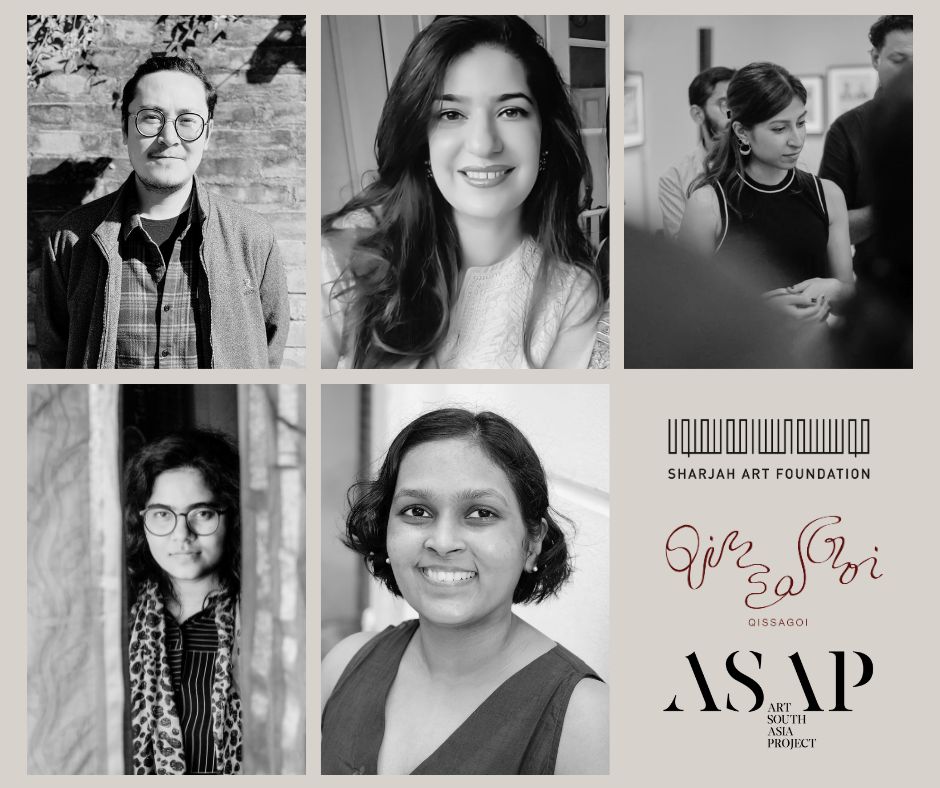
L – R Bishal Yonjan, Maliha Noorani, Pavini K Sukarchakia, Ruxmini Choudhury, Pramodha Weerasekara
About SAF Professional Development Programme
Sharjah Art Foundation’s March meeting 2026 (MM 2026) is part of their Professional Development Programme to support capacity building and long-term institutional exchange across the region. The programme invites emerging curators and arts professionals from organisations and institutions in the Middle East, Africa and Asia to attend the March Meeting and participate in a tailored week-long programme of activities designed to strengthen professional practice and foster the development of new peer and institutional networks.
Delivered alongside the March Meeting, the initiative offers targeted opportunities beyond the core MM programme. These include professional mentoring sessions with key departments at Sharjah Art Foundation, dedicated networking support to facilitate introductions with speakers and art professionals in attendance, and curated visits to leading academic and cultural institutions across the UAE. Together, these activities encourage professional exchange, knowledge sharing and the formation of sustained connections across institutions and regions.
The programme is made possible through the support of a network of regional and international funding partners, reflecting a shared commitment to supporting professional development and institutional capacity building in the arts within these regions.
About Qissagoi
QissaGoi is a community art and cultural platform celebrating the multitude of narratives of South Asia and the Middle East. In our name,Qissa Goi (storytelling in Persian and Urdu), lies our mission. Rooted in Sharjah, UAE, and reaching outward through digital storytelling and live programming, our aim is to preserve heritage, amplify Eastern voices, and connect people through the things that have always brought us together — art, food, music, fragrance, textiles, performance and the stories we tell one another.